
People might ask, “Isn’t this all overkill?”
Yes. That’s the point.
In a world where we have so little control, desktop ricing gave me a canvas where mistakes were reversible, and my anxiety became fuel for creation instead of paralysis. This system didn’t save me. But it held together long enough for me to rebuild myself.
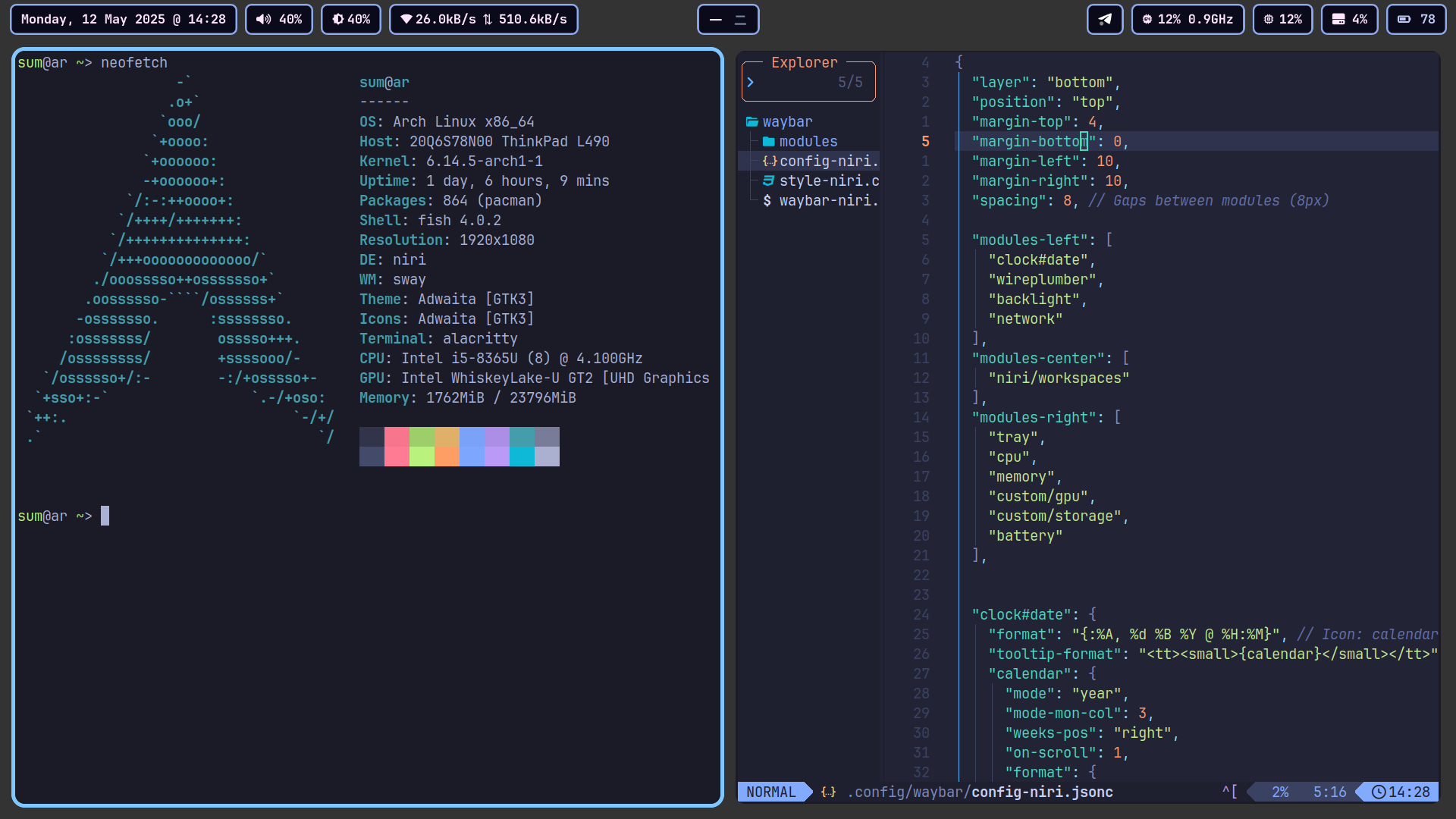
Some people run from their anxiety. I compiled mine.
It didn’t happen all at once. There wasn’t a grand plan. Just a persistent unease that needed somewhere to go. When I couldn’t control my thoughts, I started controlling my environment—one config file at a time.
Not because I wanted to suffer—though suffering came with it—but because I needed control. Arch Linux doesn’t give you comfort. It throws you into a cold shell prompt and says, figure it out. Which is exactly what I needed: No default desktop, no safety net, no pre-configured anything.
Installing Arch is like willingly stepping into the void and deciding, I’ll build the ladder on the way down.
But that’s what I needed: the feeling of control. When everything else felt unmanageable, building my system from scratch gave me structure. Every package was a decision. Every choice was mine. No bloat, no noise, no distractions. Just the core, and me.
I ditched X11 for Wayland. It’s newer, cleaner, more secure—and frustratingly incomplete. But that’s the beauty of it: it’s not done. Like me.
Enter Niri, a scrollable-tiling Wayland compositor, still maturing, still being shaped by its contributors. Using it feels like participating in something alive. There’s no bloat, no wasted space—just windows arranged with logic and precision.
I added Waybar to the top of my screen. Not for aesthetics—because there isn’t much of that—but for clarity. Time, volume, battery, workspace—exactly what I need, and nothing more. One horizontal line of status in a vertical stack of chaos.
My desktop has no wallpaper.
Just Grayscale.
Because I didn’t come here to decorate. I came here to focus. I came here to quiet the noise. The emptiness isn’t a lack of creativity—it’s an act of defiance against overstimulation. The terminal is my window.
I use systemd-boot instead of GRUB. Not because it’s trendy, but because it does what it’s told—quickly, cleanly, quietly. It boots fast, and doesn’t feel like it’s from another era.
In an ecosystem where “simple” often means “fragile,” systemd-boot is both.
Anxiety is the constant hum of what if I break it? Btrfs lets me roll back from disasters like they never happened. It’s not just a filesystem. It’s an undo button for your operating system. I take snapshots before every update, every system change, every risk. If something breaks, I roll back like it never happened.
It gave me a new understanding of safety—not as avoidance, but as resilience. Break it. Learn. Revert. Try again.
It’s the closest thing to forgiveness I’ve ever found in technology. In a way, it became a metaphor for healing: Yes, things broke. But we can go back. We can restore. We can try again.